
Collard Greens: The One That Gave us Potlikker

I eat collards all the time.
Not just on holidays, not just on New Year’s, and definitely not because I think they only belong beside a special-occasion plate. I had some this week.
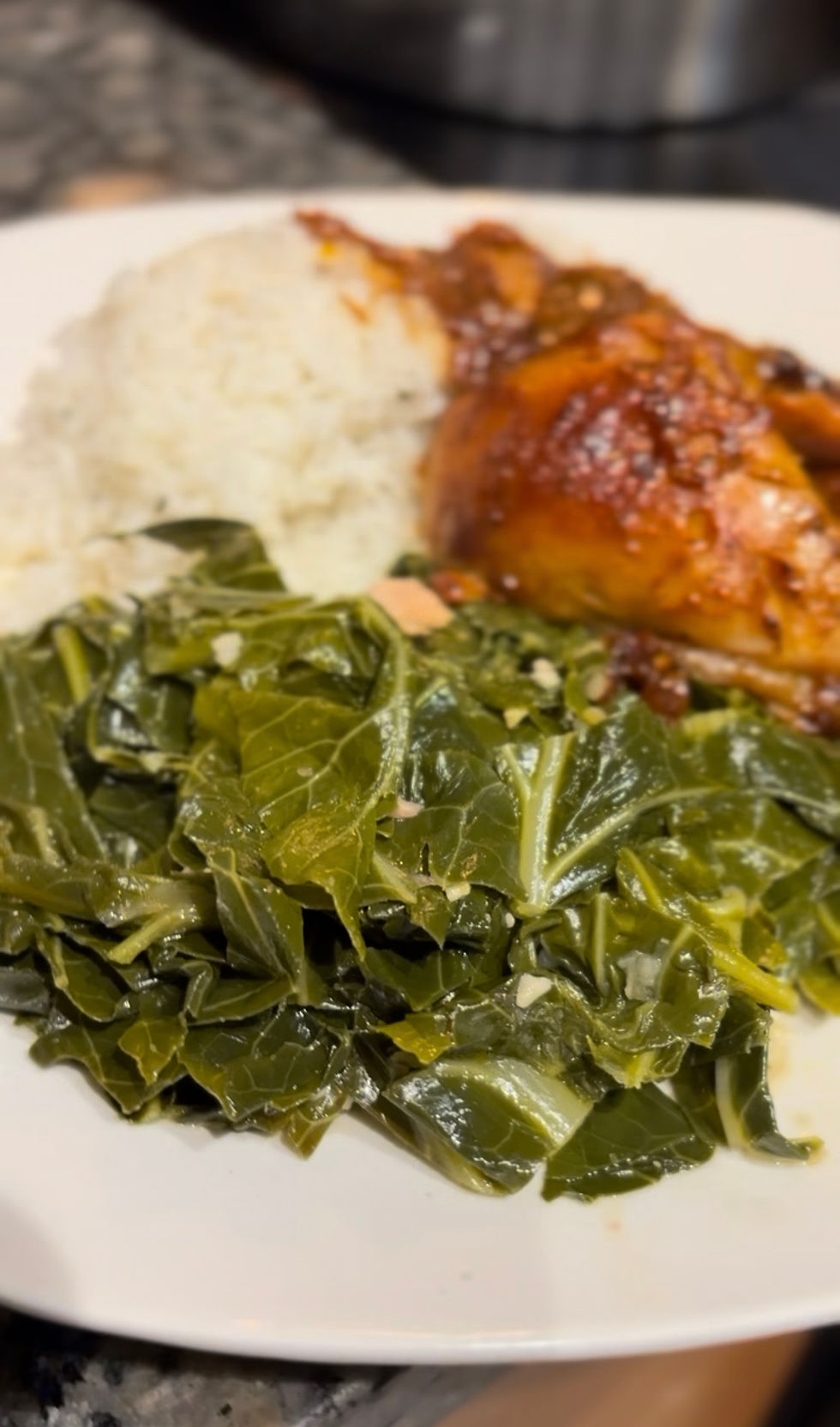
For me, collards are regular food, and the way I make them is simple once the most important part is right: the broth.
I start with smoked turkey and let it boil until the meat is tender and beginning to fall apart. Then I season the water and keep tasting it until the broth is already good enough to eat on its own. Once that part is right, the collards go in and cook until they are tender.
There is no sugar involved in my greens.
Sometimes I will add vinegar or hot sauce if someone else made them, but if I made the pot, I usually do not need either.
And I do not throw away the liquid left behind.
That is potlikker, and to me, that is part of the meal.

Where Did Collard Greens Come From?
Collards belong to the Brassica oleracea family, the same broad plant family that includes cabbage, kale, broccoli, cauliflower, and Brussels sprouts.
Leafy cabbage-family greens have been cultivated across Africa, Europe, and North America for centuries, which is part of why the origin story is not as simple as saying collards came from one place and became another culture’s food later. The National Museum of African American History and Culture specifically notes that cabbage-family greens have long histories across multiple continents.
So collards were not created by Black Americans, and they were not exclusively African.
What Black people did with them is where the story gets interesting.
Enslaved Africans brought with them traditions of cooking leafy greens, seasoning them deeply, simmering them until tender, and making use of the broth left behind. When they encountered collards and other greens in the American South, they adapted what was available to food traditions they already knew. Smithsonian food-history materials trace the Southern practice of slowly cooking greens with water, seasoning, and meat to West African foodways.
That distinction matters because Black food history is not always a story of carrying a specific crop across the Atlantic.
Sometimes what traveled was the knowledge.

What Black Cooks Did With Southern Greens
In the American South, enslaved Black people used gardens and small provision plots to supplement inadequate food rations. Greens were especially valuable because they were productive, practical, and could stretch into substantial meals when cooked with whatever meat or seasoning was available. NMAAHC describes enslaved African Americans growing greens and using meat scraps to add flavor and nutrition, a practice that later became deeply embedded in Southern food culture.
What came out of that was not merely a vegetable side dish. It was a technique.
Greens were cooked low and slow until tender. Meat seasoned the pot. The cooking liquid absorbed the flavor of everything in it. The broth was not discarded because there was no reason to waste what had become one of the richest parts of the meal.
That broth became known as potlikker.
Smithsonian food-history material describes potlikker as the richly flavored broth created when collards, kale, or similar greens are cooked slowly with seasoning and meat.
That is the point where collards stop being just a plant and start becoming Black Southern food.
Potlikker Was Never Just Leftover Water
If you grew up around collards, you already know this.
The liquid in the pot is not some unfortunate byproduct you pour away after the greens are finished.
That is where the flavor went.
Historically, potlikker carried both nutrition and value. Smithsonian materials note that during slavery, plantation owners sometimes ate the cooked greens while enslaved people consumed the remaining broth, which made potlikker an important and practical food in its own right.
That history makes complete sense to me because I still think of the broth as part of the dish.
When I make collards, the process starts there. Smoked turkey goes into the water first. I let the meat soften, season the broth, and keep working with it until it tastes right before the greens ever go in.
By the end, the potlikker has everything in it.
The smoked turkey.
The seasoning.
The greens.
The time.
I will make rice specifically so there is something on the plate to soak it up.
Potlikker has always occupied that little space between food and remedy. If you are sick, hungover, dealing with a sore throat, or your stomach is acting funny, somebody is probably going to tell you to sip some.
I have even seen somebody put a shot of it in a mixed drink.
I cannot say that is how I would use it, but it does prove people understand it is not waste.

Why Collards Worked So Well in the South
Collards also made sense agriculturally.
They tolerate cool weather, produce large leaves, and can be harvested repeatedly instead of requiring the entire plant to come out of the ground at once. That cut-and-come-again habit makes them especially practical for a family garden.
That is one of the things I love about growing them now.
I currently have Flash and Vates in the ground, and both remind me why this crop became such a dependable part of Southern food culture.
The plants are huge.
They are resilient.
They keep producing.
You can take what you need and leave the plant to keep growing.
For a crop that became important in communities where food security mattered deeply, that kind of productivity is not a small thing.
Growing collards now feels revolutionary to me because the crop still does what it has always done: it gives.
The difference is that I am planting it because I want to.
Collards, Cornbread, Rice, and the Southern Table
Collards rarely exist in isolation on the plate.
They belong beside rice, cornbread, beans, macaroni and cheese, sweet potatoes, cabbage, smoked meats, and all the other foods that make a Southern table feel like a Southern table.
For me, rice is especially useful because it catches the potlikker.
Cornbread is definitely welcome too, but I do not personally want my cornbread swimming in green juice.
Separate plate.
That is another thing food history sometimes misses when it gets too academic: culture lives in tiny preferences like that.
Who puts vinegar in the greens?
Who uses hot sauce?
Who adds sugar and gets side-eyed?
Who wants rice?
Who refuses to let cornbread touch the broth?
Those differences are not contradictions. They are proof that a food tradition is alive enough to have opinions inside it.

From Southern Food to Soul Food
Collards did not stay confined to the South.
During the Great Migration, more than five million African Americans moved from the Deep South to northern and western cities between 1915 and 1960. They carried Southern food traditions with them, and collards were among the foods that traveled. Smithsonian food historians specifically identify slow-cooked collards, sweet potatoes, cornbread, and other Southern dishes as foods that became part of African American life across the country during that migration.
That movement helped turn collards from a regional Southern crop into a national symbol of soul food.
The National Museum of African American History and Culture describes collard greens as a staple of African American cuisine and notes that Black Southerners carried the dish into new communities during the Great Migrations.
Eventually, collards became the kind of food that could make a city hundreds of miles from the South still smell like home.
That matters.
A dish can become a form of continuity when people move.
Collards Became Cultural Enough to Belong in a Museum
One of my favorite pieces of this history is that NMAAHC preserves stockpots used to cook collard greens at the historic Florida Avenue Grill in Washington, D.C.
These are not fancy ceremonial objects.
They are cooking pots.
Large, blackened, heavily used stockpots that held collards over and over again in one of the city’s historic soul food restaurants.
I love that because it proves something I think about often with food history.
An object can be ordinary enough to sit in somebody’s kitchen and important enough to belong in a museum.
The history is not separate from daily life.
The pot is the history.

Collards and New Year’s
Collards also became associated with New Year’s meals, especially in the South, where greens are traditionally linked with prosperity and money because of their color.
That tradition is familiar even to people who do not consciously follow it.
For me, collards are not something I reserve for New Year’s or cook because I am intentionally trying to attract good fortune.
They are simply part of any good celebratory meal.
That is often how traditions survive.
You do the thing long before you stop to ask where the thing came from.
My Mom’s Collards Are the Ones I Remember
When I think about collards growing up, I think about my mom’s.
That is the version that lives in my memory, and that is probably more important to me than any restaurant version or famous recipe.
The history of food happens at two levels.
There is the public history: slavery, migration, agriculture, restaurants, cookbooks, and foodways.
Then there is the private history.
The person whose pot you remember.
The way your family seasons the broth.
The smell taking over the house.
The person who taught you what “done” tastes like.
That second history is how the first one keeps moving.
Why Growing Collards Feels Different to Me
There is something about growing a crop with this much Black Southern history that feels bigger than simply harvesting vegetables.
African American gardening has long been tied to sustenance, autonomy, and cultural preservation. Smithsonian materials describe gardening and farming as ways Black communities maintained food traditions and cultural identity across generations.
That history is not abstract when I am standing in front of a row of collards that I planted myself.
Huge leaves.
Still producing.
Still useful.
Still delicious.
The same kind of crop that fed people through hard circumstances is now growing in my own Virginia soil because I chose to put it there.
That feels revolutionary without needing to make it dramatic.
My ancestors learned how to make this crop theirs.
I get to grow it because I want to.
What We Brought
Collards are a good reminder that Black food history is not always about one crop traveling directly from Africa into America.
Sometimes what traveled was a way of thinking about food.
How to season it.
How to stretch it.
How to use every part.
How to turn a broth into something worth saving.
How to make an unfamiliar crop feel familiar.
How to cook something enough times that eventually it becomes part of who you are.
Collards themselves existed across cultures, but Black Southern cooks created something culturally distinct with them. Over generations, that food traveled, changed, and stayed recognizable enough that a pot of greens can still make somebody think of home.
That is the part worth remembering.
The plant has a history.
What we did with it is the story.


Comments